Steel Truss Structure
Ball joint truss is also known as space truss. Space trusses are three-dimensional structures with longitudinal members connected at their ends by hinges assumed to be frictionless. The loads on space trusses are applied only at the nodes or joints, thus the self-weight is all...
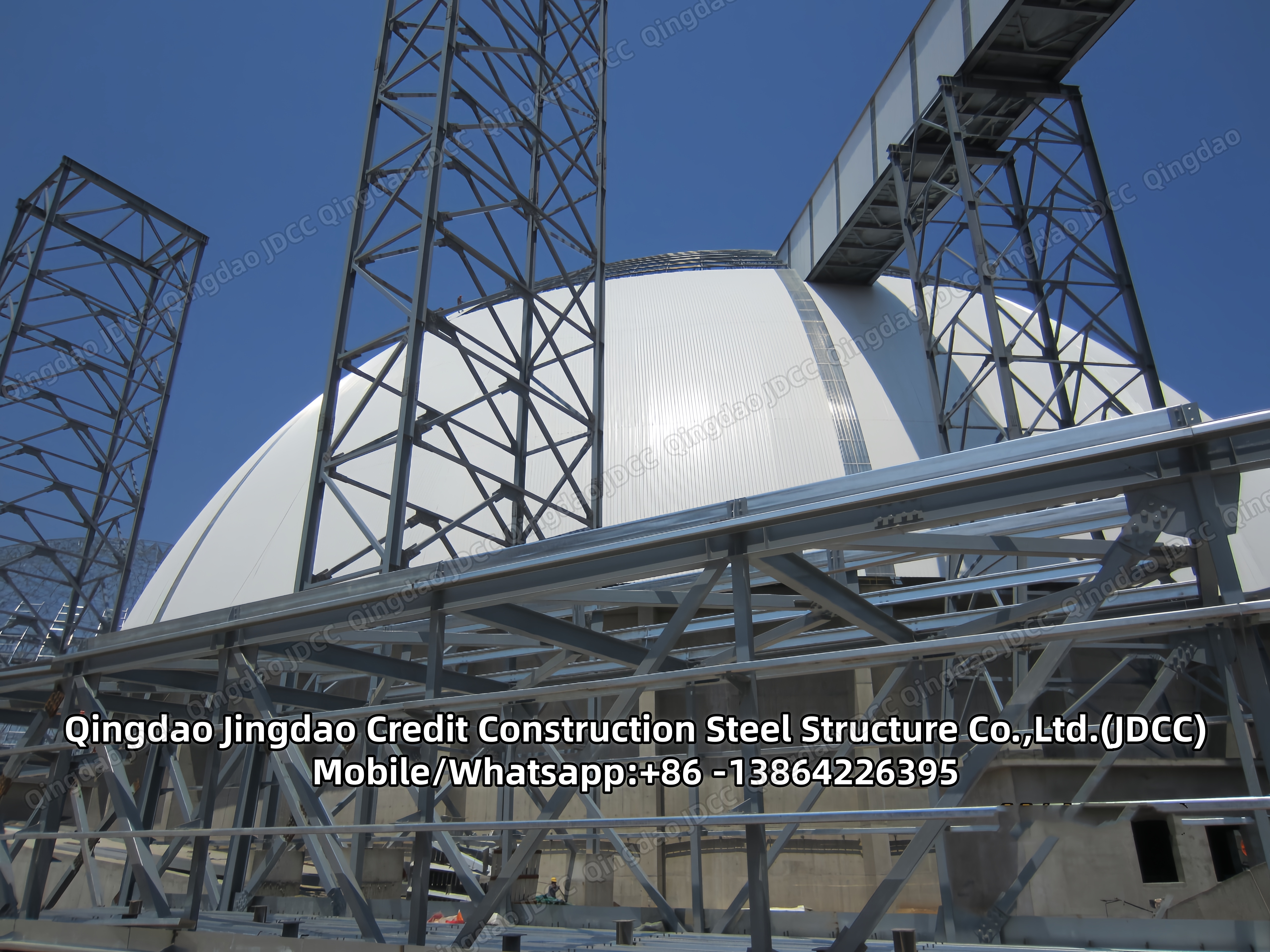
Steel Truss Structure - Products
Ball joint truss is also known as space truss. Space trusses are three-dimensional structures with longitudinal members connected at their ends by hinges assumed to be frictionless. The loads on space trusses are applied only at the nodes or joints, thus the self-weight is allocated for each element at its two ends joining other elements of the truss. The conditions imposed on space trusses are certainly the same as those on plane trusses. Essentially, the only difference in the analysis of space trusses compared with plane trusses is that an element of a space truss has three nodal coordinates at each node while an element of a plane truss has only two.
A truss is composed of triangles because of the structural stability of that shape and design. A triangle is the simplest geometric figure that will not change shape when the lengths of the sides are fixed. In comparison, both the angles and the lengths of a four-sided figure must be fixed for it to retain its shape.
The simplest form of a truss is one single triangle. This type of truss is seen in a framed roof consisting of rafters and a ceiling joist. Because of the stability of this shape and the methods of analysis used to calculate the forces within it, a truss composed entirely of triangles is known as a simple truss.
A planar truss lies in a single plane. Planar trusses are typically used in parallel to form roofs and bridges. A space truss is a three-dimensional framework of members pinned at their ends. A tetrahedron shape is the simplest space truss, consisting of six members which meet at four joints.
The depth of a truss, or the height between the upper and lower chords, is what makes it an efficient structural form. A solid girder or beam of equal strength would have substantial weight and material cost as compared to a truss. For a given span length, a deeper truss will require less material in the chords and greater material in the verticals and diagonals. An optimum depth of the truss will maximize the efficiency.